


Peer-reviewed research · UCLA
UCLA study: slackline board training improved balance up to 3x more than conventional training
In an 8-week randomized controlled trial, NCAA Division I football players who trained on a double-line GIBBON SlackBoard Pro made bigger balance gains than athletes using wobble boards, BOSU balls and foam pads.
Yamamoto et al., Sports 2025, 13, 457 · Published December 18, 2025 · doi.org/10.3390/sports13120457
- 3x Bigger gain in dynamic balanceThe composite reach score rose 9 points with the slackline board vs 3 with conventional training.
- 2x More steadiness on an unstable surfaceSway on a wobble board fell 19% vs 9% with conventional training.
- 8 wks 3 short sessions a week15–20 minutes of balance work added to regular training.
- 0 Injuries reportedEvery participant completed the study.
The short version
What the researchers found
Researchers at UCLA's UCFIT Digital Health-Exercise Physiology Research Laboratory split 30 NCAA Division I football players into three groups for eight weeks: no balance training, conventional balance training (wobble boards, BOSU balls and foam pads), or training on a portable slackline board.
Both training groups improved their static and dynamic balance; the group with no balance training did not. The slackline board group improved significantly more than the conventional group on three measures: steadiness on a wobble board, posteromedial reach and the overall composite reach score.
The authors conclude these are the first results to suggest slackline training can give elite football players balance benefits comparable to, and in some conditions greater than, conventional balance training.
Results
Bigger gains with the slackline board
Change from the start to the end of the 8-week program, by group.
Median values from Table 2 of the published study (Yamamoto et al., 2025). The differences between the slackline and conventional groups on these three measures were statistically significant (p < 0.05).
How the study worked
A randomized controlled trial with Division I athletes
30 athletes, 3 groups
Thirty male NCAA Division I football players were randomly assigned to one of three groups.
8 weeks of training
Everyone trained three times a week. The balance groups spent 15–20 minutes of each session on their program; the control group walked on a treadmill instead.
Measured before and after
Static balance: sway on a firm surface, a wobble board and a soft mat. Dynamic balance: the modified Star Excursion Balance Test.
No balance training
Same strength and conditioning program, with treadmill walking in place of balance work.
Conventional balance training
Wobble boards, BOSU balls, inflatable discs and foam pads.
- GIBBON
Slackline board training
A progressive 8-week program on the double-line GIBBON SlackBoard Pro.
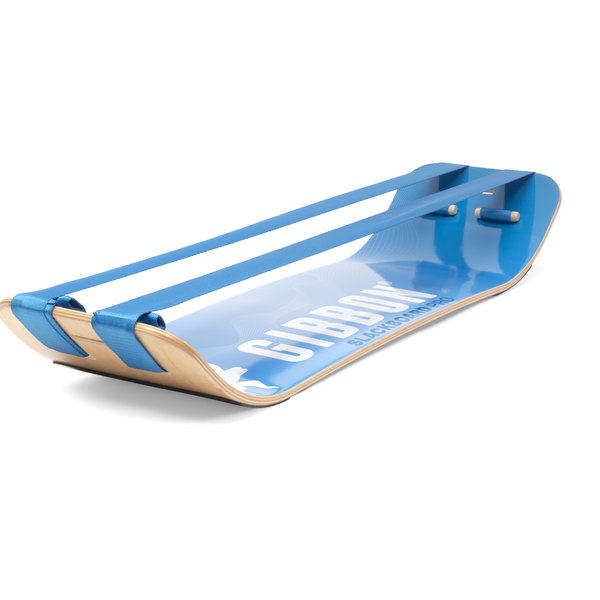
The board in the study. The researchers used the GIBBON SlackBoard Pro set up with two lines: a portable wooden slackline board measuring 1.07 m × 0.30 m and weighing 3.4 kg. That is the same size and weight as today's SlackBoard Pro (42 × 11 in, 7.5 lb), which includes both lines and can also be set up with one.
Reading it fairly
What this study does and doesn't show
Good research is clear about its limits. The authors note:
- It was a small study: 30 male football players, mostly in skill positions, so the results may not apply to everyone.
- The balance programs ran alongside the athletes' regular offseason training, which may have contributed to the gains.
- It measured balance, not injuries or sport performance. The authors call for larger studies to test those outcomes.
- The research received no external funding, and the authors declare no conflicts of interest.
The full paper
Differential Balance Enhancements Associated with Conventional Balance Training and Portable Slackline Board Training: A Randomized Controlled Trial
Loading the study…
Cite this study
Yamamoto, T.; Kidwell, J.A.; Shatagopam, V.; Hetherton, K.J.; Neufeld, E.V.; Dolezal, B.A. Differential Balance Enhancements Associated with Conventional Balance Training and Portable Slackline Board Training: A Randomized Controlled Trial. Sports 2025, 13, 457. https://doi.org/10.3390/sports13120457
Open access article distributed under the Creative Commons Attribution (CC BY 4.0) license. © 2025 by the authors. Licensee MDPI, Basel, Switzerland.
Train on the board from the study
The SlackBoard Pro brings the study's double-line setup home, with 100+ free guided videos in the GIBBON app.